
Next month marks the 100th anniversary of a signal moment in the development of the nation’s highway system.
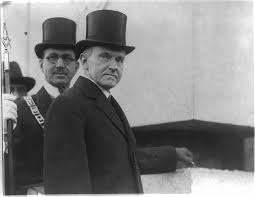
President Calvin Coolidge, never a fan of spending money anytime for any cause, put his signature on legislation authorizing $75 million in federal funds that would target both interstate and intercounty roads.
Famously tight, but not in the sense of drinking too much, Coolidge frequently complained that the White House food budget was too large, particularly when it came to dinners for guests, often was seen turning off lights in the mansion, and was not above carefully choosing the words he wrote in order to not take up so much paper.
The $75 million approved by a Republican President who once said he regarded a balanced budget “as among the noblest monuments of virtue,” led directly to the creation in November of 1926 of the U.S. Highway System which, in turn, launched U.S. Route 66.
Coolidge, who had become president in 1923 upon the death of Warren Harding, perhaps did not imagine that Route 66 would ultimately span 2,448 miles between Chicago and Santa Monica, California.
Men and women of Coolidge’s generation knew mostly dirt roads when they traveled in their Ford Model Ts or the Buick Master Sixes. When Coolidge took vacation visits to his native Vermont, he went by train. He did not even own a car until the spring of 1929 when, as a former president, he purchased a used vehicle at a discount rate from the White House fleet.
Even though Coolidge signed the 1926 highway funding legislation, he only did so cautiously. Several months earlier, according to a reporter for the San Francisco Bulletin, the President said he wasn’t crazy about giving money to state road projects. He was only, said the reporter, for backing roads that “can properly be classified as ‘main arteries’ of national importance, but is opposed to federal aid on roads of merely local importance.”
Although he finally agreed to the $75 million for interstate road construction, Coolidge maintained: “It is true that the necessity and demand for good roads are constantly increasing, but they should not be constructed faster than the taxpayers can afford to pay for them.”
In retirement, Coolidge continued to advocate for thrift in government. In remarks that most likely seem positively quaint by today’s standards, Coolidge said that such thrift was the essence of self-control: “Contentment and economic freedom are its fruits.”
Five years after Coolidge’s death in 1933, Route 66 was completed, becoming the first entirely paved highway in the nation’s history.
May 7, 2026
By Garry Boulard
Photos courtesy the Library of Congress